
The Hidden Cost of Cold Emailing Venture Capital Investors
Cold outreach is not useless, but its costs are easy to undercount: research hours, follow-ups, lost focus and a diluted reputation with the investors who would have fit.
By Backed.Ventures Editorial · Published · Last reviewed
Cold emailing investors looks cheap. A message costs nothing to send, and the occasional reply feels like proof that the method works. The real price is paid elsewhere: in research hours, in follow-ups, in founder focus and sometimes in the first impression you make on an investor who would have been a good fit.
This article is not an argument that cold outreach never works. It sometimes does. It is an argument for counting the cost honestly and for spending your outreach where it is most likely to matter.
What the evidence does and does not say
We went looking for reliable response-rate data on cold versus warm outreach to venture investors and did not find an independent dataset with a transparent method. The percentages that circulate online mostly come from vendors and blogs that sell outreach or introduction tools, and we are not going to repeat numbers we cannot trace.
There is one useful, if dated, data point. A study by DocSend with Harvard Business School's Tom Eisenmann, reported by Business Insider, looked at more than 200 seed and Series A companies. As reported, contacting more investors produced more meetings but no correlation with the amount of money raised. The report does not state when the study was done or give its full method, and it describes the pattern in the study's own terms, so read it as a hint and not a rule.
It also fits what we know about attention. DocSend says that investors spend under three minutes on a deck. If a first message does not make its relevance obvious in seconds, the reader moves on.
The cost, line by line
The numbers below are arithmetic on assumptions, not statistics. Change the assumptions to match your situation.
| Item | Assumption | Result |
|---|---|---|
| Research and personalise one email | 20 minutes each | 100 emails is about 33 hours |
| Follow up on each (two nudges) | 5 minutes per nudge | 100 contacts is about 17 hours |
| Tracking replies and updating a list | 1 hour a week over 8 weeks | 8 hours |
On those assumptions, a hundred-investor campaign costs roughly 58 founder hours before a single meeting. If the founder's time is also the company's scarcest resource, the opportunity cost is real. The point is not the exact figure. It is that "free" outreach has a price, and you should decide whether the targets justify it.
Five costs that do not show up in a spreadsheet
- Wrong-fit replies. A polite "not our focus" feels like progress and teaches you little. It also means the research step was the weak link.
- Attention drain. Hours checking an inbox and rewording follow-ups are hours not spent on customers, product or the team.
- Reputation with the right investors. If an investor who would have fit receives a generic message first, you have spent your first impression on a poor one. We cannot quantify this, and that is exactly why it is easy to ignore.
- Loss of control over your materials. Every deck sent to a stranger is a document you no longer manage. That matters if it contains numbers you would rather not circulate widely.
- Signal confusion. A long list of slow or silent investors makes it hard to tell whether the issue is your pitch, your targeting or your timing.
Why the hit rate can disappoint
Three causes are common, and none is the founder's fault.
- Mandate mismatch. The investor does not back your stage, sector, geography or cheque size, which is often hard to see from the outside.
- Timing. The investor is not deploying right now, or has just made a conflicting investment.
- Format. The message asks the reader to do the work of deciding whether it is relevant.
All three are about discovery and relevance, not about whether your company deserves backing. A pass may also mean that the fundamentals are not yet convincing, and a founder should be willing to ask that question honestly. But if you cannot tell which it was, you cannot improve.
A better way to qualify before you send
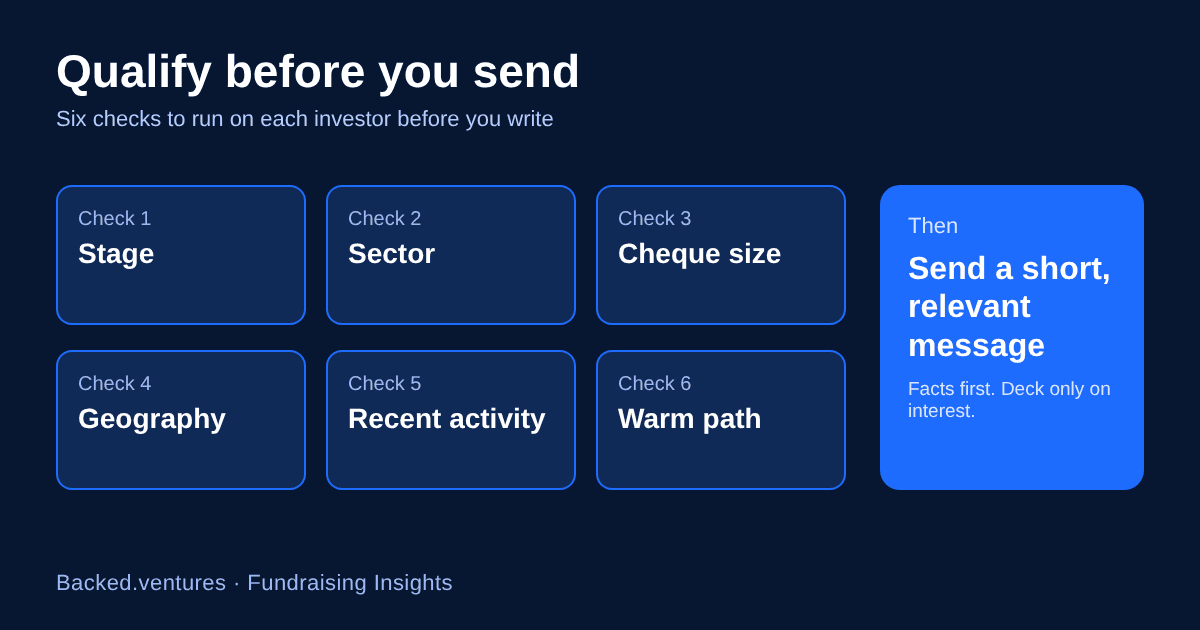
Treat each outreach as a bet and apply a short checklist before you spend the time:
- Stage: does the investor's own material say they back companies at your stage?
- Sector: have they made recent investments in your area?
- Cheque size: does your raise fall inside their usual range?
- Geography: do they invest in your country?
- Activity: is there evidence they have been investing in the last year?
- Path: is there someone you both know who could make a warm introduction? A relevant introduction is not a guarantee, but it helps the reader decide faster.
If an investor fails two or more of these, move them down your list. A short, well-qualified list usually beats a long, speculative one.
When you do send a cold message, put the deciding facts first: what you do, the stage, the raise, the country and one line of real traction. Make the deck available only to people who have signalled interest.
For investors: the cost on your side
The same inefficiency lands in an investor's inbox as sorting work. Publishing a clear mandate (sectors, stages, cheque range, geography and whether you are currently deploying) reduces the irrelevant pitches you receive and shortens the path to the ones you want.
How Backed.Ventures approaches it
Backed.Ventures is built around the qualification step. Founders publish a structured pitch with sector, stage, raise size and country. Investors set the criteria they back. Investors can filter pitches on those terms, and the founder decides who sees the deck. It does not remove the need for a good company or a good pitch, and it does not promise introductions or funding. It tries to reduce the number of messages that go to the wrong person.
See how it works, or read the pages for founders and investors.
Sources and further reading
- Business Insider: study of contacting many investors (DocSend with Tom Eisenmann, HBS) – Date and full method not given in the report
- DocSend (Dropbox): pitch deck research – Sample size not stated on the page
- TechCrunch: DocSend study of 200+ pitch decks, average 3 minutes 44 seconds (undated in the version we read)
This article is general information, not investment, legal or tax advice. Backed.Ventures is an advertising and introduction service. It does not guarantee funding or introductions, and founders and investors must do their own due diligence.