
Why Startup Fundraising Is Broken — And What Needs to Change
Capital is plentiful in aggregate, yet founders still spend months on outreach that never fits. The problem is less about quality than about discovery, relevance, timing and communication.
By Backed.Ventures Editorial · Published · Last reviewed
Backed.Ventures exists because of a frustration, so we will say what it is plainly: raising money for a startup involves a great deal of work that has little to do with building the company. This article explains where that work goes, what the evidence does and does not show, and what founders and investors can change today.
The perspective comes from experience. The idea for Backed.Ventures came out of raising investment for Device Network, a technology business developing infrastructure for the secondary-device economy. We are not going to dress that up with invented numbers or stories. We are going to describe the pattern, and then test it against published data.
The problem is not a shortage of capital
It is tempting to say fundraising is broken because there is not enough money. The data points the other way, at least in aggregate. The PitchBook-NVCA Venture Monitor, as reported by Axios, said US companies raised $412.7 billion between January and June 2026 (a record pace), with over 81% of those dollars going to deals of $100 million or more. Axios does not say whether that means committed deal value or cash actually invested, so read it as a headline measure of funding rounds, not of money in the bank.
Those two facts sit together uncomfortably. Capital is abundant, and it is concentrated. An average across the market tells a founder almost nothing about whether the right investor for their company is looking at their stage, sector and cheque size right now. That is a matching problem, not a funding-volume problem.
Where the time actually goes
Founders who have raised tend to describe the same loop. None of these steps is unreasonable on its own. Together they are slow.
- Finding investors. Hours of research to build a list of names that look plausible.
- Qualifying them. Working out whether each one actually invests at your stage, in your sector and at your size. Mandates are often vague, out of date or buried.
- Reaching them. Writing introductions and sending decks without knowing whether the recipient is deploying capital at all this quarter.
- Following up. Chasing replies that may never come, one inbox at a time.
- Repeating yourself. Re-entering the same company information across platforms, emails and calls.
The cost is not only hours. Founder attention spent here is attention not spent on customers, product or hiring.
Four places it breaks
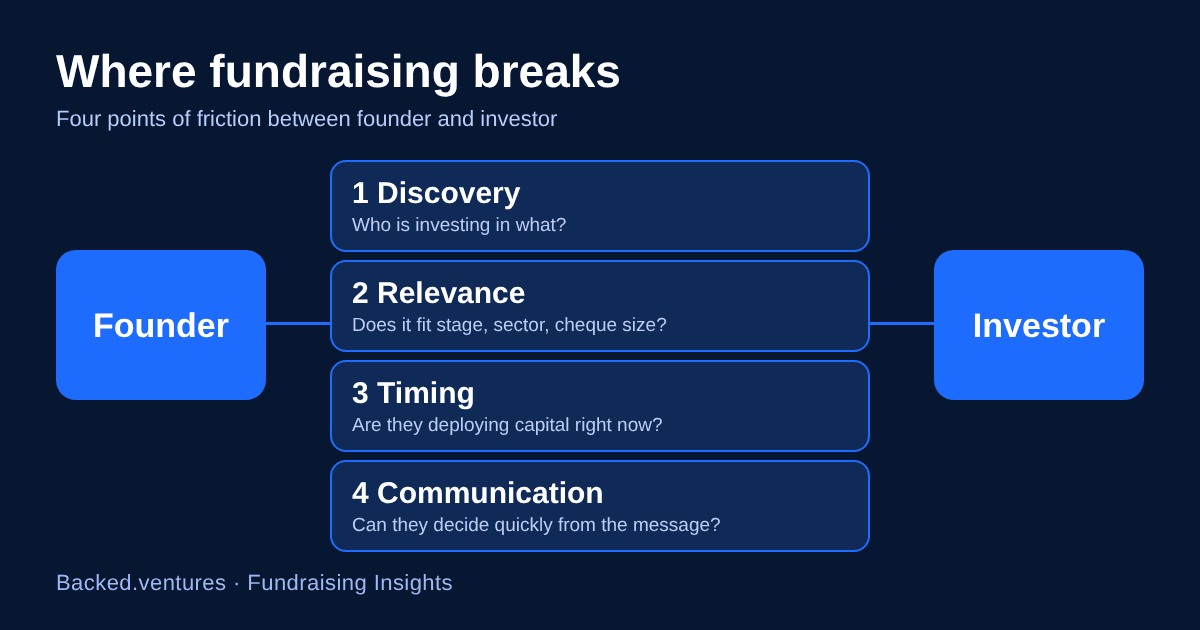
We find it more useful to name the failure than to blame anyone. The friction shows up in four places.
- Discovery. Founders cannot easily see who is investing in what, so they guess.
- Relevance. A firm can look right on the surface (right city, right buzzwords) and still be wrong on stage, sector or cheque size.
- Timing. An investor may be perfectly suited in principle and still not be deploying capital when you ask.
- Communication. A cold message with a deck attached asks a stranger to do the sorting for you.
Notice what is not on that list: investors behaving badly. Venture investors have legitimate mandates, fund constraints and portfolio limits. Saying no to a company that sits outside them is rational. The inefficiency is in how the two sides find each other.
What the evidence says, and does not say
You will often see the claim that fewer than 1% of startups secure venture capital. We have looked for the source, and we would be careful with it.
The versions we could trace go back to Kauffman Foundation material from roughly 2010 to 2015. One version says less than 1% of an estimated 600,000 new US employer businesses a year obtain VC financing. Another Kauffman-cited analysis of the Kauffman Firm Survey found 4.4% of startup funding came from VCs, and 6.5% of 479 Inc. 5000 companies had raised VC. Those numbers measure different things (firms versus dollars, all new employers versus fast-growing ones), and they are US data that is more than a decade old in places.
What they support is a modest statement: venture capital funds a small share of new businesses, and most of those businesses never intended to raise it. They do not show that 99% of founders who pitch investors are turned down. Anyone quoting that figure as a verdict on founders or on VCs is claiming more than the data can carry. We looked for a dataset that separates rejections caused by mandate mismatch from rejections caused by weak fundamentals, and did not find one. Treat anyone who gives you a precise split with caution.
Volume is not the answer
The instinctive reaction to a hard fundraise is to contact more investors. The evidence we found suggests that is not a reliable lever. A study by DocSend with Harvard Business School's Tom Eisenmann, as reported by Business Insider, covered more than 200 seed and Series A companies. It reported that contacting more investors produced more meetings but no correlation with the money raised. The report does not give its date or full method, so we treat it as indicative, not conclusive.
Attention is also scarce. DocSend says investors spend under three minutes on a deck. A message that makes the reader work to decide whether it is relevant is competing against that clock.
What to change
If you are a founder:
- Build your list from evidence of fit, not reputation: stage, sector, geography and typical cheque size, taken from the investor's own published material.
- Check recent activity. An investor's last few announced deals tell you more than their tagline.
- Put the facts a stranger needs to decide, namely sector, stage, raise size, country and traction, in the first lines of your message, not on slide 14.
- Treat a "no" as information. Ask whether it was about fit, timing or substance, and adjust.
If you are an investor:
- Publish your mandate precisely: sectors, stages, cheque range, geography and whether you are currently deploying.
- Say what you do not back. It saves everyone time.
- Make it easy to find the right place to send a pitch.
There is a short illustration (hypothetical, not a case study). Imagine a founder raising a seed round for a hardware-enabled software product who sends a deck to forty firms that all describe themselves as "early-stage technology investors". If thirty of them only write cheques at a different stage or outside that sector, the founder has spent weeks and learned very little, and those thirty investors have each spent a few minutes sorting an irrelevant pitch. Nobody did anything wrong, and nobody benefited.
Where Backed.Ventures fits
We are building one place where founders publish a structured pitch and investors state what they back, so that the sorting happens before the conversation, not during it. We do not promise introductions or funding, and we are not a substitute for judgement or due diligence on either side. Our view is simply that less of everyone's time should go on irrelevant outreach.
If you want to see how that works in practice, read how Backed.Ventures works, or go straight to the pages for founders and investors.
Sources and further reading
- Axios: Venture capital record year, citing PitchBook-NVCA Venture Monitor Q2 2026 (9 July 2026)
- SmartCompany: share of new US employer businesses obtaining VC, attributed to Kauffman Foundation research (28 May 2012) – Secondhand report; underlying dataset not named
- Kauffman Foundation (Arnobio Morelix): three facts about venture capital and entrepreneurship (13 May 2016) – Definitions and survey year not stated on the page
- Business Insider: study of contacting many investors (DocSend with Tom Eisenmann, HBS) – Date and full method not given in the report
- DocSend (Dropbox): pitch deck research – Sample size not stated on the page
This article is general information, not investment, legal or tax advice. Backed.Ventures is an advertising and introduction service. It does not guarantee funding or introductions, and founders and investors must do their own due diligence.