
Why Great Startups Get Rejected by the Wrong Investors
A pass can mean the company is weak, or that it sits outside the investor's mandate. Telling the two apart is the most useful skill in a fundraise.
By Backed.Ventures Editorial · Published · Last reviewed
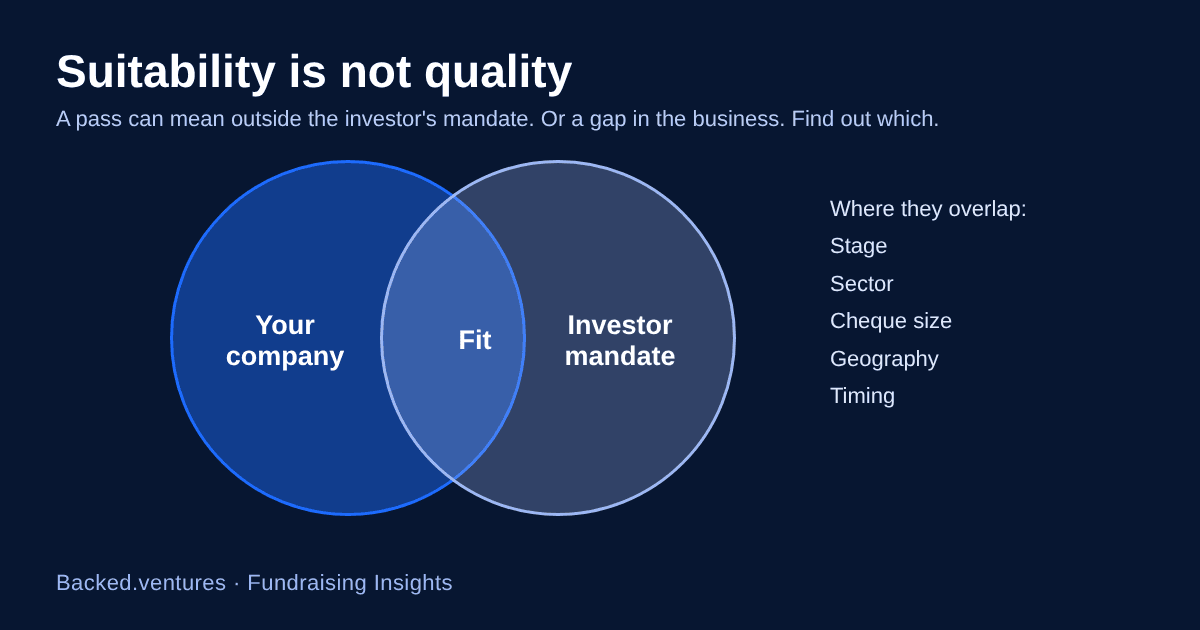
A rejection from an investor is easy to take as a verdict on your company. Sometimes it is. Often it is something narrower: your company sat outside what that particular investor, at that moment, was able to back. Telling the two apart is one of the most useful skills in a fundraise, because the right response is different in each case.
To be clear about what this article is not saying. It does not say every rejection is unjustified, and it does not say a good company deserves investment. Some passes reflect real weaknesses in the business or the pitch, and founders should want to hear them. The claim is narrower: a good company can still be wrong for a given investor, and a founder who cannot tell the difference will draw the wrong lessons.
Suitability is not quality
Investors are not choosing the best company in the abstract. They are choosing the best fit for a fund with a defined mandate. That is a legitimate constraint, not a flaw. The common ones are:
- Stage. A fund built for first cheques may not follow on into later rounds, and a growth fund may not look at pre-revenue companies.
- Sector and thesis. Many funds focus on specific areas where they believe they can add value and evaluate risk.
- Cheque size and round structure. The amount you are raising may be too small or too large for what the fund can write, or for the share of the round it needs.
- Geography. Some investors back only certain regions or need to be near the company.
- Portfolio conflicts. A fund may already back a direct competitor.
- Fund timing. A fund late in its investment period may hold back for follow-ons, however strong your pitch.
None of these says anything about whether your product works or your team is capable. They are all reasons an investor who admires a company might still say no.
What we know and do not know
We looked for data that separates passes caused by mandate mismatch from passes caused by weak fundamentals. We did not find a credible one. That matters, because anyone offering a precise percentage is guessing. What the available data does support is more modest:
- Venture capital is the source of only a small share of startup financing, and the share depends on the dataset and definition. A Kauffman-cited analysis of 479 Inc. 5000 companies found that 6.5% had raised venture capital, a reminder that fast-growing companies are built without it. (US data; the page does not give the survey year.)
- Angel-group data suggests funnels are narrow even for applicants who reach a formal process. One summary of Dealum data reports that 2 out of 100 companies applying to angel groups in 2024 reached an investor's portfolio. That is angel, not VC, data, relayed second-hand, and the page does not reconcile it with other figures it cites, so use it as context only.
- Money is plentiful in total but concentrated. The PitchBook-NVCA Venture Monitor, as reported by Axios, reports that over 81% of US venture dollars in the first half of 2026 went to deals of $100 million or more (Axios does not specify deal value versus cash invested). The headline numbers say little about whether an investor for your round is active.
How to read the reply you get
Most passes are short and polite, so you have to read between the lines. The table is a guide, not a rule.
| What you hear | It may mean | What to do |
|---|---|---|
| "Not a fit for our thesis" | Sector or model is outside their focus | Check their recent deals. If none are near yours, remove similar firms from your list |
| "Too early for us" / "Come back when you have more traction" | Stage mismatch, or traction is the real gap | Ask which milestone would change their mind. Note it |
| "The round is too small / too large" | Cheque-size mismatch | Look for funds that write your cheque size |
| "We already have something similar" | Portfolio conflict | Move on. It is rarely about you |
| "We are not investing at the moment" | Timing or fund constraints | Ask when to check back and put it in your calendar |
| Specific concerns about the market, team or economics | Substance | Take this seriously and test it with other investors |
The last row is the important one. If several investors who do fit your profile raise the same concern, that is likely feedback on the business, not on the match.
What founders can do
- Filter before you pitch. Check stage, sector, cheque size and geography against the investor's own published material.
- Ask one useful question. If an investor replies, ask a single specific question: "Was this about fit or about the business?" Many will answer in one line.
- Keep a log. Record each investor, the reason given and what you infer. Patterns across fitting investors are signal. Patterns across non-fitting investors are noise.
- Improve the pitch where the same point repeats. If investors who fit keep asking about the same thing, fix it.
What investors can do
A clearer mandate benefits both sides. Publish your sectors, stages, cheque range and geography, and say what you do not back. A pass that says "outside our mandate" is far more useful to a founder than one that says nothing, and it avoids reducing a fitting company's confidence for the wrong reason.
Where Backed.Ventures fits
We built Backed.Ventures to make fit visible earlier. Investors state what they back: sectors, stages, cheque size and countries. Founders publish a pitch carrying the same attributes. Investors can then browse pitches that match their criteria, and founders approve who sees their deck. This does not make a weak company strong, and it does not guarantee a response or funding. It aims to cut down the number of conversations that were never going to fit.
Learn more on the pages for founders and investors, or see how it works.
Sources and further reading
- Kauffman Foundation (Arnobio Morelix): three facts about venture capital and entrepreneurship (13 May 2016) – Definitions and survey year not stated on the page
- Equidam: pre-seed funding probability, summarising Dealum and Angel Capital Association data – Secondary summary of angel-group data, not VC
- Axios: Venture capital record year, citing PitchBook-NVCA Venture Monitor Q2 2026 (9 July 2026)
This article is general information, not investment, legal or tax advice. Backed.Ventures is an advertising and introduction service. It does not guarantee funding or introductions, and founders and investors must do their own due diligence.